New Phone vs Old Phone: The Complete Idiot’s Guide to Buying a Smartphone in 2026
Every year, a new batch of smartphones arrives. The Google Pixel 11 series. The Samsung Galaxy S26 series. The iPhone 18 Pro. The OnePlus 15R. The Vivo X300 series. They all promise better cameras, faster chips, and smarter AI. And every year, millions of people rush to buy them.
But here is the question nobody asks: Do you actually need the new one?
This guide will compare the latest 2026 phones with their older, similar-spec predecessors. We will talk about why you should buy new, why you should not, when to buy, and the exact conditions that should guide your decision. By the end, you will know exactly what to do.
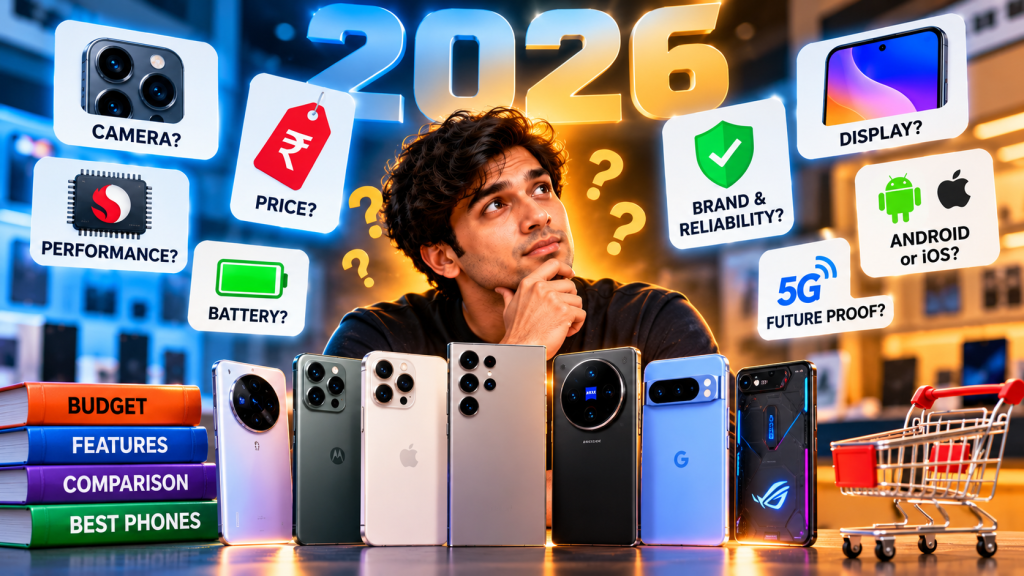
Part 1: The 2026 Phone Landscape – What Is Actually New?
Let us look at the major launches of 2026 and what they actually offer compared to last year’s models.
Google Pixel 11 Series
The Pixel 11 series was launched in August 2026. The base Pixel 11 starts at $899 (approximately ₹89,999) for the 12GB/256GB variant. It features a 6.3-inch Actua OLED display, a new 48MP primary sensor, and a 4,985mAh battery. The Pixel 11 Pro and Pro XL come with 16GB RAM options and up to 1TB storage.
What is actually new? The Tensor G6 chip, new HiLight LED flash, and improved low-light photography (the new sensor absorbs 56% more light).
What is the same? The overall design language, the camera bar, and the core software experience. The improvements are incremental, not revolutionary.
Apple iPhone 18 Pro
Apple’s 2026 flagship is the iPhone 18 Pro. It features the A20 Pro chip, the world’s first 2nm processor, with a 6-core CPU and 7-core GPU. Apple claims the GPU is 40% faster than the A19 Pro. It also has a redesigned vapor chamber that is three times larger for better thermal management, and the new C2 modem for improved 5G connectivity.
What is actually new? The gaming performance is the headline. Apple is finally taking gaming seriously on iPhone, with ports of console games like Death Stranding and Resident Evil.
What is the same? The overall form factor, the iOS experience, and the camera system are largely unchanged from the iPhone 17 Pro.
Samsung Galaxy S26 Series
The Galaxy S26 series launched in early 2026. The base Galaxy S26 starts at ₹87,999, the S26+ at ₹1,19,999, and the S26 Ultra at ₹1,39,999. The S26 and S26+ run on Samsung’s in-house Exynos 2600 chip, while the Ultra gets the Snapdragon 8 Elite Gen 5.
What is actually new? The Ultra model gets a 200MP main camera, and the standard models get slightly larger batteries (4,300mAh for S26, 4,900mAh for S26+).
What is the same? The design, the One UI software, and the overall camera experience are very similar to the Galaxy S25 series.
OnePlus 15R
The OnePlus 15R is the “flagship killer” of 2026. It launched at ₹47,999 for the 12GB/256GB variant, with a 16GB/512GB variant later released at ₹61,999. It features a massive 7,400mAh battery, Snapdragon 8 Gen 5 chipset, and a 6.83-inch 165Hz AMOLED display.

What is actually new? The battery is enormous. Most phones have 5,000mAh batteries. The OnePlus 15R has 7,400mAh, which means it can last two days on a single charge.
What is the same? The camera system (50MP + 50MP) is similar to the OnePlus 14R. The overall design is also familiar.
Vivo X300 Series
The Vivo X300 series focuses on camera performance. The Vivo X300 5G is priced at around ₹75,999, while the X300 Pro is priced at ₹1,19,999. It features a 200MP main camera, Dimensity 9500 chipset, and a 6.31-inch display.
What is actually new? The 200MP camera is the headline. It offers incredible detail and cropping flexibility.
What is the same? The overall camera philosophy and the Funtouch OS software experience are similar to the X200 series.
Part 2: Why You Should Buy the New Phone
There are genuine reasons to buy the latest model. Let us look at them honestly.
Reason 1: You Get the Longest Software Support
This is the most important reason. When you buy a new phone, you get the maximum possible years of software updates. Samsung and Google now offer 6 to 7 years of Android updates on their flagship phones. Apple typically offers 5 to 6 years.
If you buy a phone that is already one year old, you lose one year of that support. If you buy a phone that is two years old, you lose two years. For a phone you plan to keep for a long time, this matters.
Reason 2: You Get the Latest Chip and Performance
The A20 Pro in the iPhone 18 Pro is 40% faster than the A19 Pro. The Snapdragon 8 Gen 5 in the OnePlus 15R is more efficient than the Snapdragon 8 Gen 4. The Tensor G6 in the Pixel 11 is faster than the Tensor G5.
If you are a heavy user (gaming, video editing, AI apps), the latest chip gives you the best performance. But for most people, the difference is not noticeable in daily use.
Reason 3: You Get the Newest Camera Hardware
The Pixel 11’s new 48MP sensor absorbs 56% more light. The Vivo X300’s 200MP camera captures incredible detail. If photography is your passion, the new hardware matters.
Reason 4: You Get the Latest AI Features
AI is the biggest buzzword of 2026. New phones get exclusive AI features like better photo editing, smarter assistants, and on-device language models. Older phones may not get all these features.
Reason 5: You Get Peace of Mind
There is a psychological benefit to buying new. You know the phone has never been used. You get the full warranty. You get the latest everything. For some people, this peace of mind is worth the extra cost.
Part 3: Why You Should NOT Buy the New Phone
Now let us look at the other side. There are very good reasons to skip the new model and buy an older one.
Reason 1: The Price Gap Is Enormous
The Pixel 11 starts at $899 (₹89,999) . The Pixel 10, its predecessor, is now available at a significant discount. The Galaxy S26 starts at ₹87,999. The Galaxy S25 is now much cheaper.
A new mid-range phone might cost ₹40,000. A one-year-old flagship might cost the same or less, and it will have a better processor, better camera, and better build quality.
Reason 2: The Innovation Is Minimal
This is the biggest truth of 2026. Phones are barely different from their predecessors. The Galaxy S26 looks almost identical to the S25. The iPhone 18 Pro is a minor upgrade over the 17 Pro. The Pixel 11 is an incremental improvement.
The “previous generation rule” is simple: buy last year’s model. You get 95% of the experience for 70% of the price.
Reason 3: There Is a Memory Shortage Driving Prices Up
Here is something most people do not know. There is a global memory shortage in 2026, driven by the AI boom. This is making components more expensive, and those costs are being passed to consumers. Xiaomi’s president has warned of “sizeable rises in product retail prices”.
This means new phones are more expensive than they should be. Older phones, which were made before the shortage, offer better value.
Reason 4: Older Flagships Are Still Excellent
A one-year-old flagship like the Pixel 10 or Galaxy S25 is still a fantastic phone. It has a great camera, a fast processor, and years of software support remaining. For most people, it is more than enough.
Reason 5: You Can Get a Better Phone for the Same Money
If you have ₹50,000 to spend, you have two choices:
-
Buy a new mid-range phone with average specs.
-
Buy a one-year-old flagship with premium specs.
The older flagship will almost always give you a better experience. Better camera. Better screen. Better build quality.
Part 4: When Should You Buy New vs Old?
This is the practical question. Here are the conditions that should guide your decision.
Buy the NEW Phone If:
-
You are a heavy gamer. The latest chips offer the best gaming performance.
-
You are a professional photographer. The newest camera hardware matters for your work.
-
You plan to keep the phone for 5+ years. The extra year of software support matters.
-
You want the latest AI features. Older phones may not get them.
-
You have the budget and want peace of mind. There is nothing wrong with buying new if you can afford it.
Buy the OLD Phone If:
-
You are a normal user. You use your phone for calls, WhatsApp, social media, and photos. A one-year-old flagship is more than enough.
-
You are on a budget. The price difference is huge.
-
You want the best value. Older flagships offer the best specs for the lowest price.
-
You do not care about having the “latest” thing. If you are not a tech enthusiast, you will not notice the difference.
-
You are buying a phone for a family member. A one-year-old flagship is perfect for parents or children.
Part 5: The Conditions That Should Guide Your Decision
Here is a simple decision framework based on your situation.
Condition 1: Your Budget
| Your Budget | Best Choice |
|---|---|
| Under ₹20,000 | New mid-range phone (older models are too old) |
| ₹20,000 – ₹40,000 | One-year-old flagship or new mid-range |
| ₹40,000 – ₹70,000 | One-year-old flagship (best value) |
| Above ₹70,000 | New flagship (if you want the latest) |
Condition 2: Your Usage
-
Light user (calls, WhatsApp, browsing): Buy old. Any phone from the last 2 years works fine.
-
Medium user (social media, photos, videos): Buy one-year-old flagship. Best balance.
-
Heavy user (gaming, editing, AI): Buy new. You need the latest chip.
Condition 3: How Long You Keep Phones
-
Less than 2 years: Buy old. You will upgrade before support runs out anyway.
-
2–4 years: Buy one-year-old flagship. It will last you comfortably.
-
5+ years: Buy new. You need maximum software support.
Condition 4: Your Personality
-
You love having the latest tech: Buy new. You will not be happy with old.
-
You care about value and practicality: Buy old. You will save money and still be happy.
Part 6: Real-World Examples from 2026
Let us apply these rules to the phones from the image.
Google Pixel 11 vs Pixel 10
The Pixel 11 starts at ₹89,999. The Pixel 10 is now available at a significant discount. If you are not a professional photographer, the Pixel 10 gives you 90% of the experience for 60% of the price. Buy the Pixel 10.
iPhone 18 Pro vs iPhone 17 Pro
The iPhone 18 Pro’s A20 Pro chip is 40% faster. But do you need 40% faster? For gaming, yes. For WhatsApp and Instagram, no. The iPhone 17 Pro is still an excellent phone. Buy the iPhone 17 Pro unless you are a serious gamer.
Samsung Galaxy S26 vs Galaxy S25
The Galaxy S26 starts at ₹87,999. The Galaxy S25 is now cheaper. The S26 has a slightly bigger battery and a newer chip. But the S25 is still a flagship phone with a great camera and display. Buy the Galaxy S25.
OnePlus 15R vs OnePlus 14R
The OnePlus 15R has a massive 7,400mAh battery. The 14R has a 5,500mAh battery. If battery life is your top priority, the 15R is worth it. If not, the 14R is a better value. Depends on your battery needs.
Vivo X300 vs Vivo X200
The Vivo X300 has a 200MP camera. The X200 has a 50MP camera. If you love photography, the X300 is a meaningful upgrade. If you just take casual photos, the X200 is more than enough. Buy the X200 unless you are a photo enthusiast.
Part 7: The Golden Rules of Phone Buying
Here are the rules that should guide every purchase.
Rule 1: Never buy a phone on launch day. Wait at least 3 months. Prices drop, reviews come out, and you can make a better decision.
Rule 2: The previous generation rule. Buy last year’s flagship. You get 95% of the experience for 70% of the price.
Rule 3: Compare the actual selling price, not the launch price. A phone that launched at ₹80,000 and is now selling at ₹50,000 is a better deal than a new phone at ₹60,000.
Rule 4: Check the remaining software support. If an older phone has only 2 years of updates left, think twice. If it has 5 years left, it is a great buy.
Rule 5: Buy sealed, unused old stock. If you buy an older model, make sure it is brand new and sealed. Do not buy a used phone unless you trust the seller.
Rule 6: Ignore the hype. Every new phone is marketed as “revolutionary.” It almost never is. Look at the actual improvements, not the marketing.
Part 8: The Final Checklist
Before you buy any phone, run through this checklist:
-
What is my budget? Be honest.
-
What do I actually use my phone for? Most people overestimate their needs.
-
How long will I keep this phone? This determines how important software support is.
-
Is the new model actually better? Or is it just marketing?
-
What is the price difference? Is the new feature worth the extra cost?
-
Can I get a better deal on last year’s model? Almost always, yes.
-
Is the old model still sealed and unused? If buying old, make sure it is brand new.
-
How many years of updates does the old model have left? This is crucial.
Final Words: The Sensible Choice
The smartphone industry wants you to buy a new phone every year. They want you to believe that your current phone is outdated. They want you to feel like you are missing out.
But the truth is simple. Phones have plateaued. The improvements from year to year are small. The price increases are large. And the older models are still excellent.
A sensible person does not buy a phone because it is new. They buy a phone because it meets their needs at a price they can afford.
If you are a normal user, buy a one-year-old flagship. You will save thousands of rupees and still have a fantastic phone. If you are a power user who needs the latest chip and camera, buy the new model. But do it with your eyes open, knowing exactly what you are paying for.
The best phone is not the newest one. It is the one that fits your life and your wallet.