AI in Smartphones: How the Future Will Fit in Your Hand — An Industry Analysis (October 20, 2026)

Article updated: 20 October 2026. This is a multi-source industry analysis, not a report published by a single news outlet. It draws on product announcements and support documentation from Apple, Google, Samsung and Qualcomm, plus technical documentation for on-device models.
AI in smartphones is moving beyond chatbots. Phones increasingly interpret text, images and speech, find information across apps, and perform selected tasks after user approval. Availability still depends on the model, software version, language, country, app integrations and subscription.
The important question is not whether a phone carries an “AI” label. It is whether its intelligence saves time, works reliably, protects personal information and remains under the owner’s control. Recent announcements—from Apple’s next-generation Apple Intelligence architecture on 8 June 2026 to Google’s 2026 Pixel and Android updates, Samsung’s Galaxy S26 series, and Qualcomm’s September mobile platforms—show several paths toward that future. They do not prove that every promised feature is already available to every user. Apple’s announcement and Google’s Pixel announcement illustrate both the pace of development and the need to check availability details.
Key Takeaways
- AI is moving from camera and voice features to multimodal assistants and selected task automation.
- On-device models can improve responsiveness and reduce data transfers; cloud models offer more compute. Hybrid systems use both.
- AI agents can perform some multi-step tasks, but only in supported apps and markets, with safeguards still essential.
- Apple, Google, Samsung and chipmakers are embedding AI more deeply into phones and mobile processors.
- By 2030, usefulness will depend on trust, privacy, battery life, language support and affordability as much as model capability.
1. AI in Smartphones: From Apps to an AI Computer
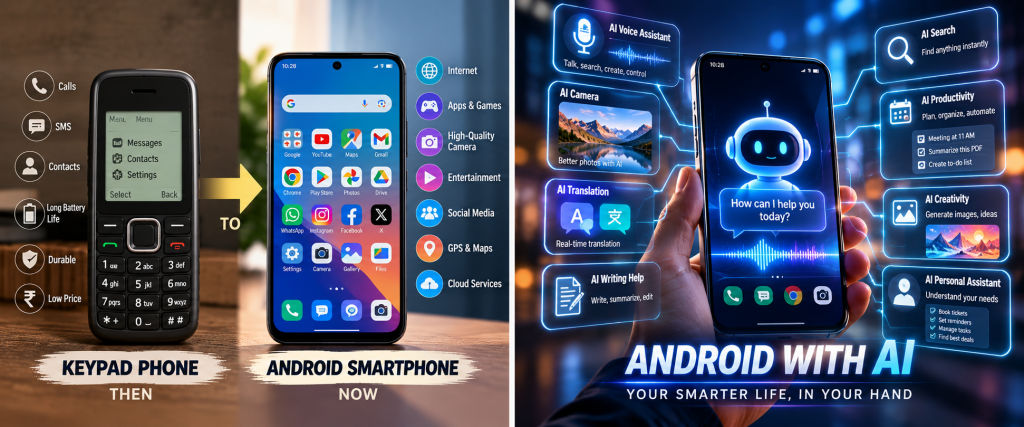
Much of the progress in AI in smartphones has grown out of technology that once worked behind the scenes. It helped cameras recognize scenes, reduce image noise, improve portraits, predict text and filter spam. Voice assistants added a conversational layer, but many requests still depended on fixed commands or a limited set of actions.
Generative AI changes the interaction model. Instead of navigating several menus, a user can describe a goal in ordinary language, attach an image, or ask for a summary. Multimodal systems can combine more than one type of input—such as a photo and a spoken question—to produce a response that relates to both.
AI is moving into the operating system itself. Samsung says Galaxy S26 can surface relevant photos or calendar context, while its Bixby agent accepts natural-language settings requests. Google has announced Gemini multi-step tasks for selected apps. Availability varies, so check the official descriptions from Samsung and Google.
| Traditional app-led interaction | AI-assisted interaction |
|---|---|
| The user opens an app and performs each step. | The user states a goal; the assistant may suggest or perform supported steps. |
| Search usually needs keywords and filters. | The user can ask a question in natural language or show an image. |
| Editing relies on menus and manual controls. | The user can describe an edit, then review the generated result. |
| Results are often limited to one service. | With suitable permissions and integrations, an assistant may combine information from multiple services. |
2. On-Device AI Versus Cloud AI
On-device AI runs models on the phone’s processor. Cloud AI sends requests to remote servers with more computing resources. Hybrid systems choose an approach based on the task and product design.

| Factor | On-device AI | Cloud AI |
|---|---|---|
| Speed | Can respond quickly because it avoids a network round trip. | Speed depends on connection quality, server load and request size. |
| Internet | Selected features can work offline after models are downloaded. | Usually needs an internet connection. |
| Privacy | Can keep some data on the phone, reducing what must be transmitted. | Data may be sent to a provider; privacy depends on its architecture, policies and settings. |
| Capability | Limited by memory, battery, chip performance and model size. | Can use larger models and server resources for demanding requests. |
| Power and heat | Heavy local processing can drain the battery and warm the device. | Reduces some local computation but still uses radio power and remote infrastructure. |
| Cost | Requires capable hardware and storage; the user may pay through the device price. | Providers face server costs and may impose usage limits or paid subscriptions. |
Hybrid designs are common. Apple says requests may run on-device or use Private Cloud Compute for more complex work. Google also provides tools for running smaller Gemma models on Android and iOS. See Apple’s privacy explanation and Google’s mobile deployment guide.
Local processing does not guarantee total privacy: apps may collect data elsewhere, and local models can still produce unsafe answers. Check what data is processed, whether it leaves the phone, how long it is retained and which controls you have.
3. What Smartphone AI Can Do Today
Photography and video
AI helps phones improve low-light images, stabilize video, separate subjects and edit pictures from natural-language instructions. Samsung’s Galaxy S26 announcement describes Photo Assist and image-creation tools. Generated edits can change details, so keep an original copy when authenticity matters. See Samsung’s Galaxy S26 overview.
Translation, speech and transcription
Speech recognition can transcribe, summarize, caption and translate. Offline use and language support vary. Have important medical, legal or official translations checked by a qualified person, especially for regional languages and dialects.
Writing and summarization
Writing tools can rewrite messages, summarize pages and structure notes. They may omit caveats or invent details, so review outputs before using them for study, work or decisions.
Search, security and accessibility
Visual search can identify items in photos, and assistants can help navigate settings or find information. AI can also support scam detection, captions and other accessibility features. Check Android 17’s feature list and your phone’s support page because availability varies by device and region.
4. The Rise of AI Agents
An AI agent plans steps and acts through approved tools or apps. A user might ask it to compare train options and prepare calendar entries, or organize messages. These examples show the direction of development, not a guarantee that every assistant can perform every task today.

Early examples already exist. Google described a beta for multi-step tasks on selected Pixel and Samsung devices, initially covering supported ride, food and grocery apps in the US and Korea. Users can monitor or stop the task. Samsung also describes agent-driven workflows on Galaxy S26, including a confirmation step before booking a taxi. See Google’s announcement and Samsung’s Galaxy S26 release. Availability changes, so check current regional support.
| Stage | Example | Important limit |
|---|---|---|
| Answer | Summarize a webpage or explain a screenshot. | The answer may be wrong or incomplete. |
| Prepare | Draft a message, build an itinerary or fill a form draft. | The user should inspect details before sending or submitting. |
| Act | Interact with a supported app to set up a ride or reorder an item. | Requires app integration, permissions, supported markets and suitable confirmation controls. |
Before an agent spends money, sends a message, deletes a file or shares personal data, it should preview the action and ask for approval. It should clarify ambiguous requests and provide a visible stop control. Google’s Android security and privacy principles emphasize user control, data protection and transparency.
5. What May Change by 2030
Forecasting the exact smartphone feature set for 2030 would be speculation. A more useful view separates capabilities available now from public development plans and reasonable scenarios.
| Horizon | What is supported by current evidence | What remains uncertain |
|---|---|---|
| Available today | AI photo tools, natural-language assistants, transcription, summarization and selected on-device models. | Consistency across brands, languages and price ranges. |
| Announced or actively developing | More proactive assistance, multi-step actions in selected apps, improved multimodal models and deeper OS integration. | How widely these functions will roll out, and how often they work correctly without supervision. |
| Plausible by 2027–2030 | More personal assistants that combine voice, text, images, location and user-approved context. | Always-on autonomous agents, reliable cross-app execution and broad adoption without new privacy or cost trade-offs. |
Smaller models are becoming more capable, and Google’s Gemma 4 documentation describes multimodal and agentic capabilities while targeting deployment scenarios that include mobile and edge devices. Qualcomm’s 22 September 2026 announcement also positions its newest premium mobile system-on-chips for the “agentic AI” era. These indicate engineering priorities, not guaranteed dates for features in every phone. See the Gemma 4 model card and Qualcomm’s September 2026 platform announcement.
A plausible future assistant could compare travel options, summarize a document and draft a reply for user review. Smart glasses, cars, earbuds and home devices may share selected context, but only if services interoperate and permissions are clear.
6. Apple, Google, Samsung and Chipmakers
Apple: system integration and a hybrid privacy approach
On 8 June 2026, Apple announced a new Apple Intelligence architecture, with Apple Foundation Models running on-device and through Private Cloud Compute. It described updates to writing, image creation and system experiences. Buyers should check eligible devices, storage, supported languages and regional availability in Apple’s support guide.
Google: Gemini across Android and Pixel
Google’s 12 August 2026 Pixel 11 announcement describes phones designed for Gemini Intelligence. Google notes that features vary by country and language, usage limits apply, and higher usage may require a subscription. See the official Pixel announcement.
Samsung: AI inside everyday Galaxy workflows
Samsung’s Galaxy S26 combines Galaxy AI with Now Nudge, conversational device controls and agent options. Its approach embeds AI in camera, messaging, search and calendar workflows. Availability depends on compatible hardware, services and setup. Details are in the Galaxy S26 release.
Chipmakers: making local AI practical
Mobile chips determine how much AI can run locally within heat and battery limits. Qualcomm’s September 2026 Snapdragon announcement highlights on-device intelligence for premium phones. MediaTek’s older Dimensity 8400 release also documented generative AI support, though it is not a claim about MediaTek’s newest 2026 hardware. Read Qualcomm’s 2026 announcement and MediaTek’s Dimensity 8400 release.
No single approach wins every category. Compare real-device accuracy, speed, battery use, update support, privacy controls, language coverage, app compatibility and total cost—not just marketing claims.
7. How AI Could Change Everyday Life
- Students: Turn class notes into revision questions, explain difficult passages or translate study material. Students should check facts and follow their institution’s academic-integrity rules.
- Professionals: Summarize meeting notes, prepare a first draft and find key points in long documents. Confidential work data should only be used with approved tools.
- Travelers: Translate signs, clarify route instructions and organize a trip. Critical bookings and travel documents still need human verification.
- Creators and small businesses: Draft product descriptions, brainstorm campaign ideas, clean up images and prepare social content. Original work and factual claims still require review.
- People with accessibility needs: Captions, speech tools, image descriptions and natural-language controls can reduce barriers, provided the tool supports the user’s language and situation.
- Everyday users: Find an old note, extract details from a document or set up a reminder without navigating multiple menus, where the operating system and apps permit it.
The greatest benefit may be removing small amounts of repetitive effort many times per day. But the value should be measured in reliable time saved—not in how many AI buttons appear in the interface.
8. Risks and Limitations
Privacy and personalization
A useful assistant may need access to messages, photos, calendar entries, location or contacts. The more context it receives, the more carefully permissions and retention rules must be designed. Review each connected service, disable access that is not necessary, and avoid sending sensitive material to tools whose data policies you do not understand.
Wrong answers and unsafe actions
AI can state false information confidently, misunderstand a request or misread details in a screenshot. Agent systems also face risks from malicious instructions hidden in messages, webpages or documents. Keep human approval for payments, purchases, sending private messages, account changes and other consequential actions. Check the recipient, amount, date and final text before confirming.
Battery, heat and upgrade pressure
Larger local models can require more memory and processing power, consume battery and create heat. Cloud AI may add connectivity needs, usage limits or fees. Component costs also affect phone prices; see IDC’s smartphone market tracker, while remembering that forecasts can change.
Unequal access and synthetic content
New features may arrive first on premium devices, in a small set of languages or in selected countries. Generated images and audio can also be used to mislead. Manufacturers should make synthetic content easier to identify, publish clear policies and provide consistent security updates. Users should check the original source before sharing a surprising claim or realistic-looking media.
9. What Consumers Should Check Before Buying
Do not upgrade only because a phone is marketed as AI-powered. First identify tasks you actually need and then check whether a particular model supports them in your country and language.
- Confirm specific features. Check the manufacturer’s current support page, not only the launch presentation.
- Check the device requirement. Some tools require a recent processor, a minimum amount of memory, free storage or a newer operating system.
- Review privacy settings. Find out what runs locally, what is sent to the cloud and whether data is retained or used to improve services.
- Check subscriptions and limits. Advanced models may have daily caps or require paid access.
- Look for long-term updates. AI software changes rapidly, so software-support commitments matter.
- Test everyday reliability. Prioritize battery life, camera quality, performance, repair options and price alongside AI tools.
For Indian buyers, verify local language support and feature availability specifically for India. A feature shown in a US demonstration may not be available with an Indian account, an Indian-language setting or the same phone variant.

10. Frequently Asked Questions
What is AI in smartphones?
AI in a smartphone means software that can recognize patterns, understand language, analyze images, generate text or media, and help with tasks. Some functions run directly on the device, while others use cloud servers. The name covers many different tools, so it is important to check what a specific phone actually supports.
Can AI run on a phone without the internet?
Yes, some AI models and features can run locally after the required model and language files are downloaded. Camera enhancement, selected text tasks and some speech or security functions may work offline. More demanding requests or cloud-based assistants generally need a network connection. Offline support is feature-specific, not guaranteed for every AI tool.
Will AI assistants replace smartphone apps?
Not completely in the near term. Assistants can make apps easier to operate, find information and prepare tasks, but the apps and services still provide account access, specialized workflows and final controls. Some actions may be automated only in supported apps, and payments or other important steps should retain user confirmation.
Which companies offer AI smartphone features?
Apple, Google and Samsung are integrating AI into phone software and everyday tasks. Qualcomm and MediaTek develop mobile chips that help run AI workloads, while other phone makers use a mix of their own software and third-party models. Exact features depend on the device, software version, region, language and service provider.
Is on-device AI safer for privacy?
It can reduce the amount of personal information sent to remote servers, which is a meaningful advantage. However, on-device processing does not automatically make every part of an app private or prevent inaccurate outputs. Check the app’s permissions, data practices, cloud fallback behavior and available privacy controls.
Will AI smartphones need more RAM and processing power?
Many advanced local models benefit from faster neural-processing hardware and more memory, although efficient smaller models can run on a wider range of devices. Actual requirements vary by feature and software. Check official system requirements rather than assuming that every new AI function requires the most expensive phone.
What could AI smartphones look like by 2030?
A plausible scenario is an assistant that can work across voice, images, documents and compatible apps, while sharing selected context with accessories and other devices. This is a forecast, not a confirmed product roadmap. Its success will depend on trustworthy actions, clear privacy choices, useful integrations and affordable hardware.
11. Conclusion
The future of AI in smartphones is less about replacing the touchscreen and more about what happens after a user expresses an intention. Phones may increasingly summarize, translate, create, search and perform approved actions across services. Recent releases show industry investment, but a press release does not prove every feature is ready for every user.
The most valuable AI phone will be the one that understands the task, handles it accurately, explains what it is doing and asks for approval when the decision matters. Reliability, privacy, battery life, language coverage and price will determine whether this new layer feels genuinely helpful—or merely adds complexity. For consumers, the best next step is to evaluate actual supported features rather than buy based on the AI label alone.
12. Sources and Further Reading
- Apple Intelligence brings powerful AI capabilities into everyday experiences — Apple Newsroom, 8 June 2026.
- How to get the next generation of Apple Intelligence — Apple Support (India), current compatibility and setup documentation; accessed 20 October 2026.
- Apple Intelligence and privacy on iPhone — Apple Support, Apple Intelligence privacy explanation; accessed 20 October 2026.
- Here’s your first look at the newest Pixel devices — Google Blog, 12 August 2026.
- Check out what’s new in Android 17 — Google Blog, 16 June 2026.
- Let Gemini handle your multi-step daily tasks on Android — Google Blog, 25 February 2026.
- Android’s Agentic Future: Building Gemini Intelligence on a Foundation of Security & Privacy — Google Security Blog, 12 May 2026.
- Samsung Unveils Galaxy S26 Series: The Most Intuitive Galaxy AI Phone Yet — Samsung Global Newsroom, 26 February 2026.
- Snapdragon Leads the Agentic AI Age with Two of the World’s Fastest Mobile SoCs Powering the Next Generation of Smartphones — Qualcomm Newsroom, 22 September 2026.
- Deploy Gemma on mobile devices — Google AI for Developers, on-device mobile deployment guide; accessed 20 October 2026.
- Gemma 4 model card — Google AI for Developers, Gemma 4 model card; accessed 20 October 2026.
- Smartphone Market Share — International Data Corporation (IDC), smartphone market tracker, updated 17 September 2026.
- MediaTek Unveils the Dimensity 8400, the First All Big Core Chip for Premium Smartphones — MediaTek, Dimensity 8400 announcement; older 2024 reference used only as historical context.
Editorial note: Features, device compatibility, language coverage, markets and subscription requirements change over time. Confirm the relevant manufacturer’s live support page before making a purchase or assuming that a feature is available in your region.