U.S. POLITICS · ECONOMY · HOUSEHOLD AFFORDABILITY
America’s 2026 Midterm Elections: Political Promises, Rising Prices, and the Struggle of Ordinary Families (October 20, 2026)
Article Updated: October 23, 2026
With the November 3 vote approaching, control of Congress is being contested against a backdrop of elevated fuel costs, persistent price pressure, uncertain consumer confidence, and competing promises about taxes, health care, housing, and household relief.
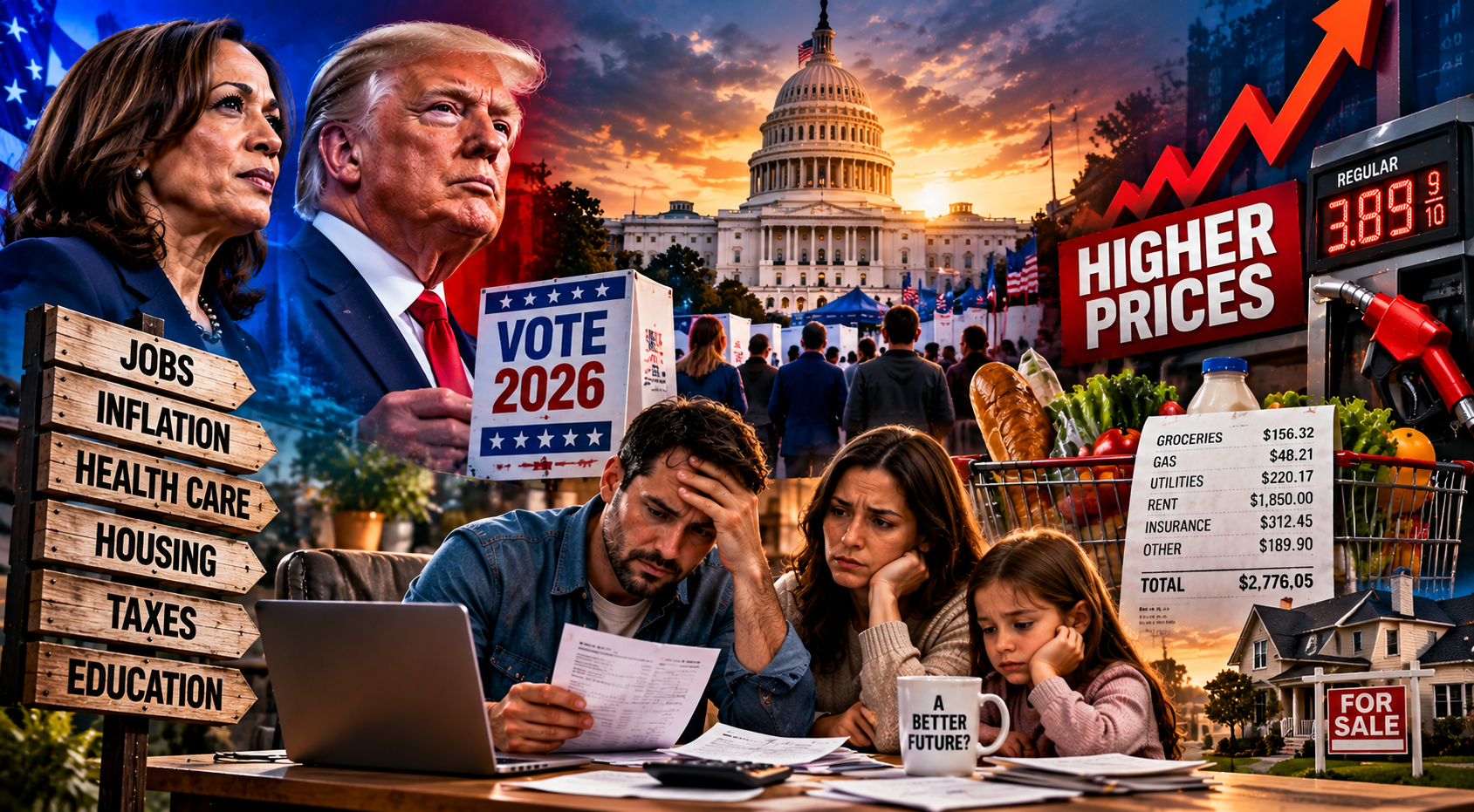
The November 3, 2026, midterm elections will not decide who becomes president; President Donald Trump is not on the ballot. They will determine who controls the U.S. House of Representatives and Senate for the final two years of his term, while voters will also choose governors and other state and local officials. Republicans currently hold narrow congressional majorities, and Democrats need a net gain of four seats in each chamber to take control, according to Reuters’ October 20 analysis. Read Reuters’ midterm-election analysis ↗ Check the official federal election date ↗
For many families, the campaign debate is less about an abstract economic growth figure than about whether a paycheck covers the grocery bill, rent or mortgage, health insurance, utilities, fuel, child care, and debt payments. Inflation is the rate at which prices rise; affordability is whether household income can keep up with the actual level of those prices. Even when inflation cools, people may still face a high cost of living because prices do not automatically return to earlier levels.
Current polling makes that distinction politically important. In an AP-NORC poll conducted October 8–12 and published October 15, 85% of voters said the economy was among the most important issues in their vote, while 84% said the same of the cost of living. The survey also found widespread dissatisfaction with the direction of U.S. politics. Polls describe public attitudes at a moment in time; they are not predictions of which party will win individual races. Read the AP-NORC polling results ↗
Key takeaways
- The midterms are scheduled for Tuesday, November 3, 2026; control of both chambers of Congress is at stake.
- September consumer inflation rose 3.7% over the year, while gasoline prices were up 34.2% year over year, according to the Bureau of Labor Statistics.
- Republicans are highlighting tax-law changes and targeted relief announcements; Democrats are framing the race around affordability, health-care costs, and congressional oversight.
- Some promises—such as a proposed $5,000 household payment—are not enacted benefits and lack a confirmed, funded implementation mechanism.
- Families are affected differently: a tax deduction may help eligible workers, but it cannot automatically offset higher rent, fuel costs, health premiums, or reduced benefit eligibility.
- The election result will shape legislation, oversight and budgets; it will not instantly or single-handedly determine grocery prices, mortgage rates, or wages.
1. Why the 2026 midterms matter
Midterm elections are a referendum of sorts on the governing party, but voters also evaluate local candidates, state-level issues, and the choices offered by challengers. All 435 House seats and 35 Senate seats are scheduled for election in 2026, alongside numerous gubernatorial and state contests. The Senate map and close House districts matter as much as national mood: a national polling lead does not guarantee victory in every state or congressional district. Review the national issues shaping the campaign ↗

If Republicans retain control of both chambers, they will have an easier path to advance Trump’s legislative agenda, shape committee investigations, and set the congressional calendar. If Democrats win one or both chambers, they can block or reshape some legislation, scrutinise executive-branch actions, and use committee powers to investigate policies and administration decisions. Either outcome still requires negotiation, procedural steps, and sometimes bipartisan votes.
The election is also a test of whether the administration’s economic message matches voters’ day-to-day experience. Strong stock-market headlines or a low unemployment rate may coexist with financial stress among households facing high housing, energy, insurance, and debt costs. At the ballot box, voters may weigh national indicators, their personal finances, and which party they trust to act next.
2. What the latest cost-of-living data show
The latest official Consumer Price Index release available by October 23 covers September 2026. The CPI for all urban consumers rose 0.6% in September after a 0.4% increase in August; prices were 3.7% higher than a year earlier. The monthly increase was driven heavily by energy: gasoline rose 9.1% in September and the energy index rose 5.2%. These are nationwide index measures, not a statement that every household experienced the same change. Read the September CPI report ↗
| Measure | Latest reported change | Why it matters |
|---|---|---|
| All-items CPI | +3.7% year over year; +0.6% in September | The broad price basket continued to rise. |
| Gasoline | +9.1% in September; +34.2% year over year | Raises direct transport costs and can feed into delivery and production costs. |
| Food at home | +1.8% year over year | Grocery inflation was slower than headline inflation, but the price level remained high. |
| Food away from home | +3.5% year over year | Restaurant meals and prepared food added pressure to some budgets. |
| Shelter | +3.2% year over year | Rent and housing-related costs remain a large, recurring expense. |
The gasoline figure deserves care: the BLS measure shows a year-over-year increase, not the amount each driver paid at a particular station. Fuel prices vary by region, grade, taxes and travel patterns. Still, a large move in gasoline can be felt quickly by commuters, delivery drivers, farmers, and businesses dependent on transport. See the BLS gasoline price data ↗
Consumer sentiment also reflects anxiety. Reuters reported on October 23 that the University of Michigan consumer-sentiment index edged down to 48.0 in October from 48.1 in September, close to its recent record low. The survey’s one-year inflation expectations rose to 4.7%, up from 4.6% in September and 3.4% in February. Expectations are not the same as actual future inflation, but they can influence purchasing, saving and price-setting decisions. Read the latest consumer-sentiment report ↗
3. Why families can feel squeezed even when the economy grows
Household budgets depend on income, essential expenses, debt and savings. A renter facing a lease renewal experiences inflation differently from a homeowner with a fixed mortgage; a long-distance commuter feels fuel increases more directly than a remote worker. A worker receiving a raise may still lose financial flexibility if insurance, childcare, utilities and borrowing costs rise faster.
Inflation is cumulative. When the rate of price increases slows, prices do not automatically return to the levels people paid several years earlier. That is why officials may point to a lower inflation rate while families still describe groceries or rent as unaffordable. Both can be true: the rate of increase and the price level are different measures.
Oil prices can flow through the economy beyond the gas station, affecting trucking, agriculture, packaging, air travel and the cost of moving goods. But the size and timing of those effects vary. Campaign claims that tariffs, the Iran conflict or a specific domestic policy caused a price change should be tested against the data, not accepted solely because the events happened at the same time.

The practical voter question is whether disposable income is improving after essentials and debt payments. That answer differs by household size, region, housing status, income, occupation and health-insurance arrangements.
4. Republican promises: tax cuts, targeted aid and the delivery test
Republicans are highlighting the federal tax law enacted in 2025, which extended many earlier tax cuts and added deductions for some qualified tips, overtime pay, car-loan interest and seniors. The IRS describes the provisions and eligibility rules through its “Working Families Tax Cuts” resources. For eligible households, these measures can reduce taxable income or change refunds. But a deduction is not the same as a dollar-for-dollar payment: its value depends on the taxpayer’s circumstances, the qualifying amount and the applicable limits. Read the IRS guide to family tax changes ↗
The law has also become a source of disagreement because it reduced Medicaid and food-assistance funding and changed eligibility requirements. The Associated Press reported on the law’s uneven distributional effects and the Congressional Budget Office’s projections that millions could lose health coverage once requirements take effect. These are projected effects, not a statement that every person facing a change has already lost coverage. Supporters stress tax relief and incentives; critics argue that lower-income households could lose benefits worth more than any tax gain they receive. Read AP’s analysis of the tax law’s mixed impact ↗
Farm support and fuel relief
On October 20, Trump announced an $8 billion “harvest fuel relief” programme intended to help farmers offset diesel costs during the 2026 harvest season. Reuters reported that USDA would distribute one-time payments through the Farm Service Agency, based on a formula tied to modeled losses. This is a targeted programme for eligible farmers, not a universal household payment or a direct rebate at every gas station. Its eventual reach will depend on eligibility rules, application procedures and the amount paid to individual recipients. Read Reuters’ report on the farmer aid programme ↗
The proposed $5,000 payment
Trump has also promoted a proposed $5,000 government payment to adults if Republicans retain control of Congress. AP reported that the funding mechanism had not been fully modelled publicly, that the proposal could cost more than $1 trillion, and that even some supporters questioned whether the payments would materialise. As of October 23, it should be described as a proposal or campaign promise—not an enacted benefit, approved appropriation, guaranteed check or amount households should include in their budgets. Read AP’s report on the proposed $5,000 checks ↗
The broader lesson is that “tax relief” and “cash support” are different mechanisms. A tax deduction may help workers who qualify and have income against which to claim it. A targeted farm payment helps a specific sector. A broad check would need clear legal authority, funding, eligibility rules and administrative delivery. Voters should ask each campaign for the amount, timetable, source of funding, who qualifies, and whether the proposal has passed the steps needed to become real.
5. Democrats’ affordability message: health care, daily costs and oversight
Democrats are campaigning on a cost-of-living agenda and criticising the effects of the Republican tax-and-spending law, particularly reductions in Medicaid and food assistance. An August Reuters/Ipsos poll found Democrats held an eight-point advantage over Republicans in voter trust on cost of living, although many respondents were unsure or favoured neither party. Individual Democratic candidates differ in emphasis, including health-care affordability, housing supply, child care, wages and oversight. {ext(“reuters_costpoll”, “Read Reuters/Ipsos on trust to handle costs”)} {ext(“apnorc_oct15”, “Review the October AP-NORC survey”)}
Republicans counter that lower taxes can leave eligible workers with more take-home pay, while benefit reductions can restrain federal spending. Democrats argue that tax benefits may be unevenly distributed while cuts to health coverage or food assistance can hurt households with limited savings. These are competing policy judgments about growth, incentives, public services and the federal deficit; their effect should be measured by who qualifies, who loses support and how the changes are funded.
The October AP-NORC survey found that 80% of voters wanted substantial change or a complete upheaval in how the country is run, while only about one in ten said they were optimistic about U.S. politics. Dissatisfaction does not automatically mean voters have settled on the opposition: some distrust both parties, prioritise other issues, or may not turn out. {ext(“apnorc_oct22”, “Read the latest AP-NORC priorities poll”)}
6. Health care and housing could decide close races
Affordability extends beyond food and fuel. Health coverage, deductibles, prescription drugs, property insurance, rent, child care and home financing are large recurring expenses. Republican tax-law changes may benefit eligible taxpayers, while Medicaid reductions and tighter eligibility rules raise concerns about coverage for some low-income households. The impact on a particular family depends on income, state rules, employer coverage, premiums and the effective dates of the changes.
Housing: an executive order is not an instant price reduction
On October 22, Trump signed an executive order aimed at lowering certain costs for single-family home buyers and borrowers. Reuters reported measures involving mortgage-insurance premiums, refinancing, manufactured housing and interest rates on some government-backed loans. The effects depend on agency implementation and borrower eligibility. A change to financing rules may help some borrowers, but it does not by itself increase the number of homes in high-demand locations or guarantee lower prices. {ext(“reuters_housing”, “Read Reuters’ report on the housing-cost order”)}
These issues matter because the cost of health care and housing can reshape a household budget for years. Congress can change funding, taxes and programme rules, but a single vote cannot instantly change local housing supply, lender pricing or the cost of medical services in every market.
7. What can Congress actually change after the election?
Congress can influence taxes, federal spending, health programmes, immigration law, agency oversight and appropriations. Control of a chamber affects committee leadership and which bills receive hearings or floor time, but the practical result depends on margins, Senate rules, presidential veto power, courts, agency implementation and whether lawmakers agree on the details.
| Issue | Campaign promise | What to verify |
|---|---|---|
| Taxes | Cuts, deductions, refunds or payments | Eligibility, funding, enacted status and start date |
| Health care | Lower premiums, drug prices or benefit changes | Premiums, deductibles and affected groups |
| Housing | Lower mortgage costs or more homes | Supply, rates, eligibility and implementation |
| Food and fuel | Lower energy costs or targeted assistance | Global prices, supply chains and pass-through effects |
| Oversight | Investigations and transparency | Evidence, congressional authority and likely remedy |
A single election outcome does not guarantee that gasoline, grocery prices or mortgage rates will fall. Businesses, households and markets respond to economic data, global conditions, central-bank policy and expectations about future legislation. Congressional control changes the path of policy, but it is only one factor in a complex economy.
8. A practical way to evaluate promises before voting
For ordinary families comparing candidates, the best approach is to turn political language into a testable household question:
- Ask for the policy mechanism. Is the promise a tax deduction, refundable credit, direct payment, subsidy, regulation, or proposed law?
- Check who qualifies. Income limits, work status, age, state residency, benefit enrolment and other conditions can exclude people from an advertised benefit.
- Look for funding and legislative status. Is the measure already law, an agency action, a proposal, or a campaign statement? Has funding been appropriated? Are the rules published?
- Compare the net household effect. A tax benefit may help one side of the budget while premiums, rent, fuel or reduced benefits raise the other side.
- Check the date and source. Polls have field dates and margins of error; inflation reports cover defined months; campaign claims may describe plans that have not been independently costed.
- Separate national from local issues. Housing markets, state Medicaid policies, electricity rates, wages and local tax burdens vary significantly by location.
For election logistics, voter registration, polling place details and access rules, use the official election office for the state where you are registered. The Federal Election Commission confirms November 3, 2026, as the next regularly scheduled federal general election date, while state and local authorities administer voting. Open the FEC’s official voting-information page ↗
Conclusion: the election promises meet the monthly budget
America’s 2026 midterms are being shaped by a clear tension: political leaders are promising tax relief, household support, lower costs or stronger oversight, while many voters remain worried about the price of essentials. September data show that inflation accelerated and gasoline rose sharply; polling shows cost of living remains a top concern. Neither fact alone determines the outcome, but together they explain why affordability has become a defining political test.
The next Congress can influence taxes, health coverage, spending, oversight and housing policy. It cannot guarantee an immediate drop in every family’s bills. The most credible campaign promise is therefore the one that names the actual mechanism, identifies who benefits, acknowledges trade-offs, and can be evaluated after it is implemented. For voters, the key question is not simply who promises relief—but what relief is realistically deliverable, to whom, on what timetable, and at what cost.
Frequently asked questions
When are the 2026 U.S. midterm elections?
The federal general election is Tuesday, November 3, 2026. Voters will choose members of the House and Senate and participate in state and local contests where scheduled. The president is not on the ballot.
Why is the cost of living such a major issue?
Households must cover recurring expenses such as food, fuel, housing, insurance, health care and utilities. September CPI rose 3.7% over the year and gasoline rose 34.2% over the same period, according to BLS. Household experiences vary by location and spending patterns.
Are the proposed $5,000 checks guaranteed?
No. As of October 23, 2026, the proposal had not become an enacted benefit with confirmed funding, eligibility and delivery details. AP reported uncertainty about its funding mechanism and a possible cost above $1 trillion. It should not be treated as guaranteed household income.
What did the 2025 tax law change?
It extended earlier tax cuts and created or expanded deductions for some qualified tips, overtime, seniors and eligible auto-loan interest. Eligibility and limits apply, and tax benefits vary by taxpayer. The law also changed health and food-assistance funding and eligibility rules.
Do national polls predict the election result?
No. Polls measure sampled opinion at a particular time and have sampling error. House and Senate results depend on state and district contests, turnout, candidates and the electoral map, not only national percentages.
Sources and references
This is an independent analysis based on official economic and election information, public polling, and reporting about current campaign proposals. The title is publisher-supplied and is not attributed to a single outlet.
- Reuters — “Three issues defining the 2026 US midterm elections,” October 20, 2026.
Read Reuters’ election analysis ↗ - AP-NORC — “Ahead of the midterms, most voters cite the economy and cost of living as top issues and favor political change,” October 15, 2026.
Read the AP-NORC poll ↗ - AP-NORC — Voters’ priorities for the next Congress, October 22, 2026.
Read the October 22 poll report ↗ - U.S. Bureau of Labor Statistics — September 2026 Consumer Price Index release, October 14, 2026.
Read the official CPI release ↗ - U.S. Bureau of Labor Statistics — “Prices for gasoline increased 34.2 percent over the year ended September 2026,” October 16, 2026.
Read the gasoline-price data ↗ - Federal Election Commission — election and voting information.
Check the official election date and voting resources ↗ - Internal Revenue Service — Working Families Tax Cuts: individuals and workers.
Read the IRS tax-provision guide ↗ - Associated Press — analysis of the 2025 tax law’s mixed impact on voters.
Read AP’s tax-law analysis ↗ - Associated Press — report on the proposed $5,000 payments, October 2026.
Read AP’s report on the proposed checks ↗ - Reuters — $8 billion farmer fuel-relief programme, October 20, 2026.
Read Reuters’ farm-aid report ↗ - Reuters — housing-cost executive order, October 22, 2026.
Read Reuters’ housing report ↗ - Reuters — U.S. consumer sentiment near record low, October 23, 2026.
Read the consumer-sentiment report ↗ - Associated Press — economic indicators before the November 3 midterms.
Read AP’s economic fact check ↗ - Reuters/Ipsos — voters’ trust in parties to address cost of living, August 25, 2026.
Read the Reuters/Ipsos poll ↗
More evidence-based explainers
Follow the numbers, check the source, and compare campaign promises with the policies that actually pass and reach households.
Editorial note: This article is general political and economic analysis, not voting advice or an endorsement of any party. Polls, economic measures and campaign proposals are time-sensitive and should be checked against the linked original sources before republication.