INDIA POLITICS · DEMOCRACY · ELECTORAL RIGHTS
India’s Right to Peaceful Protest: Voter Lists, Detentions, and the Continuing Debate Over Democratic Rights (October 20, 2026)
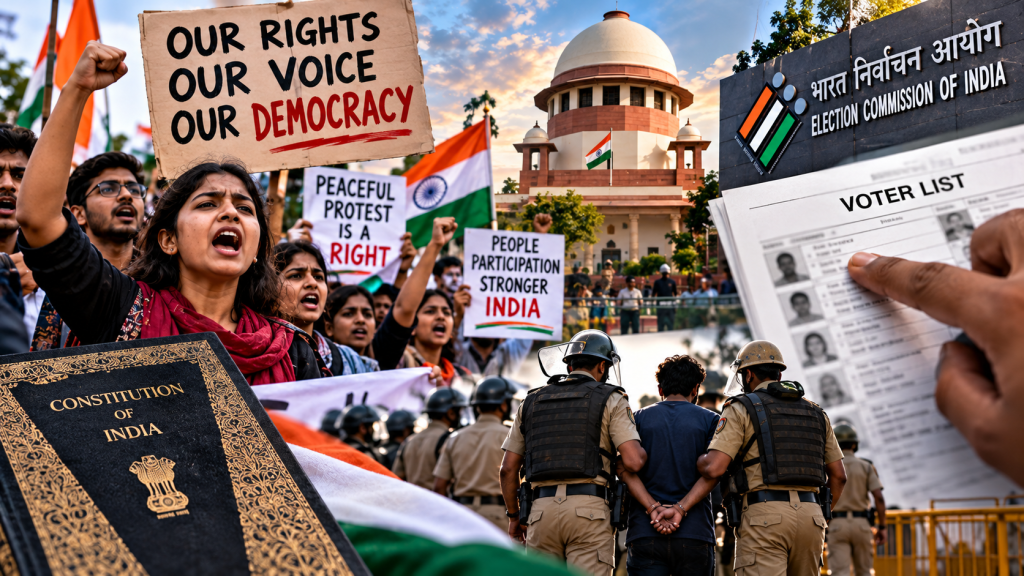
A voter’s name on an electoral roll is the practical link between political participation and the ability to cast a ballot. When a large revision overlaps with protests, detentions, transport restrictions and internet disruptions, the issue is no longer only administrative. It also concerns how people challenge public decisions, how officials explain their actions, and what remedies remain available when a process goes wrong.
The immediate dispute centres on the Election Commission of India’s phased Special Intensive Revision (SIR) of electoral rolls. Protesters and opposition parties say the exercise risks excluding eligible voters and have demanded accountability from Chief Election Commissioner Gyanesh Kumar. The Commission’s stated rationale is to remove deceased, duplicate, shifted or otherwise ineligible entries and to identify eligible people left out; the Commission and the BJP deny political manipulation. Read Reuters’ October 20 reporting ↗ Read about the Election Commission’s special enrolment drive ↗
Both sides of this dispute need to be examined with evidence. A large number of deleted entries does not, by itself, establish how many were eligible voters wrongly removed or prove a political motive. Equally, a stated goal of cleaning a roll does not establish that every decision was correct or that every affected voter could use the correction process in time.
Key takeaways
- Reporting has described roughly 13 crore entries removed during the nationwide SIR process. That figure is not a verified count of eligible voters wrongly excluded.
- The Election Commission says the revision is designed to identify ineligible entries and has directed a special drive to enrol eligible voters left out of the rolls.
- Rights organisations and UN experts have raised concerns about detentions, use of force, internet restrictions and access to protest locations; these are attributed assessments, not findings that every individual police action was unlawful.
- Article 19 protects speech and peaceful, unarmed assembly, while allowing specified reasonable restrictions for public order and other constitutionally listed grounds.
- The Supreme Court’s October 11 directions were interim and addressed detention, transport, movement, internet access and professional duties, subject to lawful public-order conditions.
- The most useful test is concrete: what reasons were recorded, what safeguards were followed, how quickly errors were corrected, and whether restrictions were tailored to evidence of risk.
1. How the voter-list dispute became a protest issue
The Election Commission describes the Special Intensive Revision (SIR) as a phased effort to verify electoral rolls and identify entries linked to deceased, permanently shifted, duplicate or otherwise ineligible voters. Accurate rolls matter, but errors matter too: a legitimate voter removed by mistake needs a timely, accessible way to correct the record.
The dispute sharpened as reports emerged about the scale of changes and voters who said they had been incorrectly marked absent or dead. Reuters’ October 20 account described people trying to restore their registration, including an individual who said a roll entry wrongly identified him as deceased. The report also noted a substantial change in Delhi’s draft roll. Individual examples are important for showing how mistakes can affect a person, but they do not by themselves prove how common an error is nationwide. Read Reuters’ October 20 reporting ↗
Demonstrations and police action followed across several dates. Amnesty International’s October 2 statement described detentions and restrictions during protests in Delhi and Mumbai. Reuters reported extensive security measures and mass detentions around the October 10 Delhi protest, while the Associated Press also reported that police intercepted people travelling toward protest sites and that journalists were among those temporarily detained. Different reports count different locations and periods, so their figures should not be added together as if they measured one common total. Read Amnesty International’s October 2 account ↗ Read Reuters on the UN experts’ statement ↗ Associated Press — “India cracks down on youth protests as anger grows against Modi and election chief” (October 2026) ↗

The Supreme Court issued interim directions on October 11. Human Rights Watch raised concerns on October 13; Amnesty International and partner organisations issued a further statement on October 19; and Reuters reported on October 20 that UN independent experts sought an impartial investigation into reported excessive force. These remain attributed assessments rather than judicial findings on every incident. Read the Indian Express report on the October 11 order ↗ Read Human Rights Watch’s October 13 statement ↗ Read the October 19 joint rights-group statement ↗ Read Reuters on the UN experts’ statement ↗
The story had not ended by October 23. The Indian Express reported that more than 100 people were detained during a march in central Delhi opposing the SIR and the Chief Election Commissioner. Its report did not establish the duration or outcome of each detention, so the number alone cannot answer whether each one was lawful. It does show that protests continued beyond the first large mobilisation. Read the October 23 detention report ↗
2. What the numbers mean—and what they do not
The “13 crore names removed” figure requires careful wording. Reports describe entries removed from draft rolls or affected during revision; a draft-stage change, a final deletion, a duplicate entry and an eligible voter wrongly excluded are different categories.
| Reported measure | What it helps establish | What it does not establish |
|---|---|---|
| Roughly 13 crore entries removed during the nationwide SIR process, as reported in October | Shows the scale of the revision and the need for a transparent category-by-category account. | Does not show how many eligible voters were wrongly excluded or establish one reason for every entry. Read about the Election Commission’s special enrolment drive ↗ |
| About 4.2 million entries missing from Delhi’s August 31 draft list, according to Reuters’ reporting | Shows a major change between roll snapshots in Delhi. | Not a verified count of wrongful deletions; reasons and appeal outcomes need case-level review. Read Reuters’ October 20 reporting ↗ |
| Detention counts reported for October 10 and subsequent protest days | Shows the scale of the policing response and the need to examine individual grounds and procedures. | Figures from different places and periods cannot be added without matching definitions. Associated Press — “India cracks down on youth protests as anger grows against Modi and election chief” (October 2026) ↗Read the October 19 joint rights-group statement ↗ |
| More than 100 demonstrators reportedly detained on October 23 | Shows that demonstrations continued after the October 10 events. | Does not establish the lawfulness of each detention or its outcome. Read the October 23 detention report ↗ |
A useful public dashboard would publish deletion reasons, contact/notice rates, claims, objections, restorations, appeal outcomes and processing times, clearly distinguishing preliminary from final figures while protecting personal data. An aggregate number alone cannot establish accuracy, fairness or political motive.
That is why the Election Commission’s instruction for a special drive to enrol voters who may have been left out deserves attention alongside the original deletion totals. The Indian Express reported that the Commission directed states and Union Territories where the exercise had been completed to conduct the drive, using Form 6 as the route for re-entry without the SIR questionnaire. The measure is relevant evidence of a corrective mechanism, but its practical value depends on access, deadlines, awareness and how quickly applications are decided. Read about the Election Commission’s special enrolment drive ↗
3. The constitutional framework: a protected right, not an unlimited one
Article 19(1)(a) protects citizens’ freedom of speech and expression, while Article 19(1)(b) protects their right to assemble peaceably and without arms. Article 19(1)(d) also protects citizens’ freedom to move throughout India. These rights give people constitutional space to criticise policy, seek accountability and assemble around a shared grievance. Read the official Constitution of India ↗ Read the text of Article 19 ↗
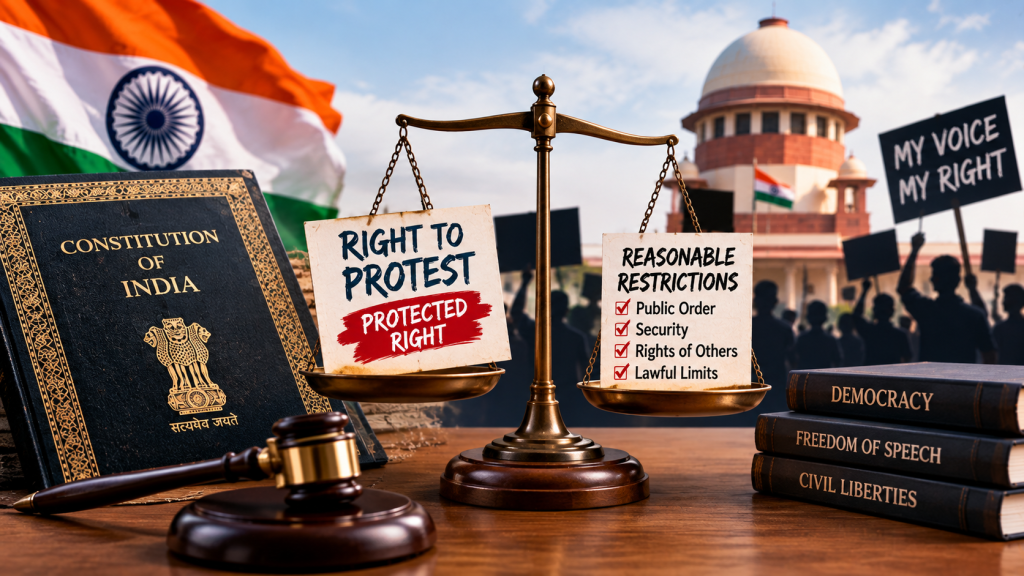
The protection is not absolute. Article 19(3) permits reasonable restrictions on peaceful assembly in the interests of India’s sovereignty and integrity or public order. The legal analysis is therefore not simply “protesters always prevail” or “public order always prevails”. It turns on the legal authority relied upon, the facts supporting the restriction, its geographic and temporal scope, how it is enforced, and whether the response is proportionate to the risk described.
Article 21 protects life and personal liberty, and Article 22 contains safeguards relating to arrest and detention. The exact procedural requirements depend on the circumstances and the applicable law. In any individual case, a news report cannot substitute for the detention record, the order relied upon, legal representation or judicial review. The Bharatiya Nagarik Suraksha Sanhita (BNSS), 2023, includes Section 163, a mechanism for urgent orders in specified circumstances to prevent danger, obstruction or disturbance. The existence of that power does not, by itself, resolve whether a particular order was necessary, properly framed or lawfully applied. Consult the BNSS text on India Code ↗

The Supreme Court’s 2020 judgment in Amit Sahni v. Commissioner of Police recognised the constitutional significance of peaceful protest while holding that public ways cannot be occupied indefinitely in a way that obstructs others. UN Human Rights Committee guidance on peaceful assembly similarly highlights proportionality and accountability; it informs the discussion but does not replace Indian law. Read the Supreme Court’s 2020 judgment ↗ Read UN General Comment No. 37 on peaceful assembly ↗
4. Detentions, movement restrictions and the Supreme Court’s interim directions
During the October demonstrations, news organisations and rights groups reported barricades, restrictions around protest locations, mobile-internet disruptions, transport interruptions and detention of people trying to reach gatherings. Some reports also described journalists and legal professionals being detained or impeded while working. These are serious claims, but they should remain attributed until the underlying records and proceedings establish what occurred in each case. Associated Press — “India cracks down on youth protests as anger grows against Modi and election chief” (October 2026) ↗ Read Human Rights Watch’s October 13 statement ↗ Read the October 19 joint rights-group statement ↗
On October 11, a Supreme Court bench issued interim directions in proceedings concerning the Delhi protest response. Reporting on the directions said authorities should ensure there were no illegal detentions, allow free movement subject to traffic rules, keep metro and rail facilities functioning normally unless public-order conditions justified restrictions, restore internet service subject to law-and-order conditions, review barricades, and avoid impeding lawyers, journalists and other professionals. The Court also addressed the position of peaceful assemblies in areas not covered by prohibitory orders. Read the Indian Express report on the October 11 order ↗
The order was interim: the Court issued notices and sought responses, rather than conclusively finding that every detention or restriction was unlawful. Later reporting described further petitions and scrutiny of allegations concerning journalists. The status of an individual detainee, the wording of a Section 163 order, and the records of police action matter more than a generalised statement about the entire event. Read the legal explainer ↗
A later development also matters to the timeline. The Indian Express reported that Cockroach Janta Party leaders Saurav Das and Ashutosh Ranka were released on October 22 after seven days in judicial custody, following a written undertaking about future protest calls at Jantar Mantar until the site was legally denotified. Their release does not resolve the wider arguments over the legality of earlier restrictions or every other detainee’s case, but it shows why updates should distinguish detention, remand, release conditions and final judicial findings. Read the October 22 report on the leaders’ release ↗
Rights-group reports and government explanations should also be read according to their roles. Human Rights Watch and Amnesty International are advocacy organisations documenting alleged violations; Reuters, AP and Indian Express provide reporting; court orders state judicial directions; and police or government statements explain the state’s position. These are different types of evidence. A responsible account identifies them clearly rather than treating an allegation, a press release and a judicial finding as equivalent.
5. The Election Commission’s position and the test of an effective correction process
The Commission says electoral-roll revision is intended to improve accuracy by removing ineligible entries and ensuring eligible citizens are registered. This is a legitimate administrative objective in principle: inaccurate rolls can exclude people in practice and can also weaken confidence in election outcomes. The controversy is about implementation—how identities and addresses were checked, how people were contacted, how deletion reasons were recorded, and how an affected person can challenge the result.
There is also an important legal development: on 27 May 2026, the Supreme Court upheld the Election Commission’s authority to conduct the Bihar SIR in Association for Democratic Reforms v. Election Commission of India. That judgment upheld the exercise in the Bihar case; it does not prove that every individual entry in later phases was handled correctly, nor does it decide whether particular October protest detentions were lawful. Those remain separate, fact-specific questions. Read the official Supreme Court judgment ↗
The Commission and government point to safeguards such as draft-roll publication, claims and objections, recorded decisions and appeal routes. Official statements describe the process’s intended protections; independent evidence is still needed to assess access and outcomes in practice. Read the government’s statement on SIR safeguards ↗ Read the ECI SIR instructions ↗
There is also a live, state-specific deadline to keep separate from the national debate. A Press Information Bureau update says the Election Commission extended the period for claims and objections in Delhi until October 30, 2026, at the request of the Delhi Chief Electoral Officer. This is a Delhi-specific update in the cited notice; voters elsewhere should check their own state Chief Electoral Officer’s current schedule rather than assume the same deadline applies nationwide. Read the government notice on the Delhi claims period ↗
Two tests matter: was a specific entry removed correctly, and did the affected person have a realistic chance to find out, respond and appeal in time? A valid objective can still produce errors; the remedy is part of the assessment.
Karnataka reporting has also noted a sharp rise in Form 7 objections ahead of a final roll. This is not proof of wrongdoing, but it underlines the value of transparent data on objections, grounds and outcomes. The Indian Express — “From 58,475 to 2.28 lakh: Voter-deletion form spike casts fresh shadow on Karnataka SIR” (October 23, 2026) ↗
Opposition parties and protest organisers allege political bias; the Commission and BJP deny manipulation. The aggregate number cannot establish intent. Evaluation requires comparable regional data, recorded deletion reasons, audit trails, objections and restoration outcomes.
6. Who bears the cost when systems fail?
A missing voter entry can cost money and time. Daily-wage workers may lose pay to visit an office or attend a hearing; people whose documents show old addresses, older people, people with disabilities and those without reliable internet may face extra friction. These are foreseeable barriers, but their prevalence must be established with data and case-level evidence.
Protest restrictions can also affect commuters, students, businesses, journalists and families trying to contact a detained person. Authorities must manage genuine safety risks, but should explain why any restriction is necessary and how its impact on essential movement and services is limited.
7. Questions that can distinguish evidence from allegation
| Question | What would help answer it? |
|---|---|
| Were eligible voters wrongly left out? | Reasons recorded for removal, notice records, claim outcomes, restoration rates, final-roll comparisons and independent audits. |
| Were restrictions on assemblies proportionate? | The written order, its legal authority, location and duration, stated risks, alternatives considered and records of review. |
| Were individual detentions lawful? | The legal grounds, detention or arrest records, access to counsel, release information and judicial review. |
| Were journalists or lawyers obstructed? | Contemporaneous documentation, identification records, witness accounts, official explanations and any findings from investigations. |
| Did safeguards work in practice? | How many people received notice, how accessible the claims process was, average processing times, accepted and rejected appeals, and geographical patterns in outcomes. |
8. What voters can do if their name is missing
- Check the official record. Search the Election Commission’s Voters’ Service Portal rather than relying on a forwarded screenshot or an unofficial intermediary. Open the ECI Voters’ Service Portal ↗
- Read the current notice for your state and revision stage. Forms and deadlines can differ by stage and purpose. An earlier deadline or form instruction may no longer apply.
- Use the prescribed route. Form 6 is generally used for inclusion in the electoral roll; follow the current official directions for inclusion after SIR or for corrections and objections. If in doubt, contact the Electoral Registration Officer or state Chief Electoral Officer.
- Keep records. Save acknowledgement numbers, copies of applications and relevant official replies. Avoid uploading identity documents publicly or sending them to unofficial agents.
- Escalate unresolved cases through official channels. Ask the local election office about the status and applicable review or appeal procedure. For a detention or urgent legal issue, seek qualified legal assistance; this article is not case-specific legal advice.
Keep copies of relevant records, protect personal documents, and avoid posting identity details publicly. For a detention or urgent legal issue, seek qualified legal assistance.

Review voter-check steps See the evidence checklist
Frequently asked questions
Is peaceful protest a fundamental right in India?
Yes. Article 19 protects freedom of expression and citizens’ right to assemble peaceably and without arms. Those rights are subject to specified reasonable restrictions, including for public order. Whether a particular restriction is lawful depends on its authority, evidence, scope, duration, manner of enforcement and applicable judicial review. Read the text of Article 19 ↗
Does every name removed from a voter list represent wrongful deletion?
No. Revisions may remove entries for death, duplication or relocation, but errors can also occur. A total number of changes does not show how many eligible voters were wrongly excluded; case-level evidence, appeal outcomes and final-roll data are needed.
What did the Supreme Court say about the October protests?
On October 11, the Court issued interim directions concerning detention, movement, public transport, internet service and access for professionals, subject to legal and public-order conditions. It did not issue a final judgment proving every allegation or declaring every detention unlawful. Read the Indian Express report on the October 11 order ↗
How can someone check or restore their voter registration?
Use the official ECI Voters’ Service Portal, read the latest instructions for the state and revision stage, submit the prescribed form, and keep an acknowledgement. If there is no response or the case is rejected, ask the Electoral Registration Officer about the review or appeal route currently available. Open the ECI Voters’ Service Portal ↗
Have allegations of political manipulation been proved?
Opposition parties and protest organisers allege bias; the Commission and BJP deny manipulation. The deletion total alone does not prove motive. Assessment requires deletion reasons, comparable regional data, restoration outcomes, procedural audits and findings by competent authorities or courts.
Conclusion: democratic trust depends on fair process
Accurate electoral rolls matter, but accuracy is not measured only by how many entries are removed. It also depends on identifying eligible voters, explaining decisions, correcting errors quickly and applying rules consistently.
Peaceful assembly gives citizens a way to challenge decisions. Authorities can regulate gatherings to manage genuine risks, but restrictions and detentions need lawful grounds and must fit the circumstances. The October 11 Supreme Court directions underscore procedure and oversight without finally resolving every allegation.

Democratic trust is tested by two practical questions: can a voter obtain timely review, and can peaceful demonstrators express dissent without unlawful detention or unnecessary restrictions? Transparent data, reasoned orders, accessible remedies and independent scrutiny are how institutions answer them.
Sources and references
- Reuters — “Declared dead: Indian voters fight to get back on electoral rolls” (October 20, 2026) ↗
- Reuters — UN experts urge investigation into alleged excessive force at protests (October 20, 2026) ↗
- Associated Press — “India cracks down on youth protests as anger grows against Modi and election chief” (October 2026) ↗
- Human Rights Watch — “India: End Crackdown on Protesters, Arbitrary Detentions” (October 13, 2026) ↗
- Amnesty International and partner organisations — “India: End the crackdown on peaceful protests and release arbitrarily detained protesters” (October 19, 2026) ↗
- Amnesty International — “India: Authorities trampling on human rights in crackdown on electoral roll protests” (October 2, 2026) ↗
- The Indian Express — “After 13 crore names dropped from draft rolls, EC orders ‘left out’ voter drive” (October 2, 2026) ↗
- The Indian Express — “Over 100 detained in Delhi during protest against election panel chief” (October 23, 2026) ↗
- The Indian Express — “From 58,475 to 2.28 lakh: Voter-deletion form spike casts fresh shadow on Karnataka SIR” (October 23, 2026) ↗
- The Indian Express — “No illegal detentions, restore Metro, internet services: Supreme Court on Delhi protests” (October 12, 2026, reporting the October 11 directions) ↗
- The Indian Express — Legal explainer on Delhi protest restrictions and the Supreme Court’s approach (October 2026) ↗
- Government of India — Constitution of India, official text ↗
- India Code — Constitution of India, Article 19 ↗
- India Code — Bharatiya Nagarik Suraksha Sanhita, 2023 ↗
- Election Commission of India — Voters’ Service Portal ↗
- Press Information Bureau — ECI’s Special Intensive Revision of Electoral Rolls: stated safeguards (July 25, 2026) ↗
- Supreme Court of India — Association for Democratic Reforms v. Election Commission of India, judgment dated 27 May 2026 (Bihar SIR) ↗
- Supreme Court of India — Amit Sahni v. Commissioner of Police, judgment dated October 7, 2020 ↗
- United Nations Human Rights Committee — General Comment No. 37 on the right of peaceful assembly (September 17, 2020) ↗
- The Indian Express — Cockroach Janta Party leaders released after seven days in custody (October 22, 2026) ↗
- Press Information Bureau — Election Commission update, including Delhi claims and objections extended to October 30, 2026 ↗
More evidence-based explainers
Explore more public-interest explainers and practical guides on TechUHelp. For developing legal or election issues, compare the date of each report with the latest official notice or court order.
Editorial note: Figures and allegations are attributed to the sources reporting them. The Constitution and legal context are summarised for general information, not legal advice. Court directions are described as interim where applicable.